
Why a Pilates studio has physical therapists on staff
Most people meet physical therapy in a clinic. You go twice a week for a few weeks, you get a sheet of exercises, and at some point you are discharged. Then you are on your own, trying to figure out whether the gym down the street, a group fitness class or a Pilates studio is safe for the shoulder or back you just spent two months rehabbing.
At Pilates MN, licensed physical therapists and physical therapist assistants work in the same building as our Pilates instructors, on the same equipment, with the same clients. That one detail changes how rehab ends. Instead of a handoff on paper, your therapist can walk across the room and tell your instructor which movements to keep, which to discard, and what to watch for. We wrote a short piece on that PT-to-instructor handoff if you want the background.
What our physical therapists actually do
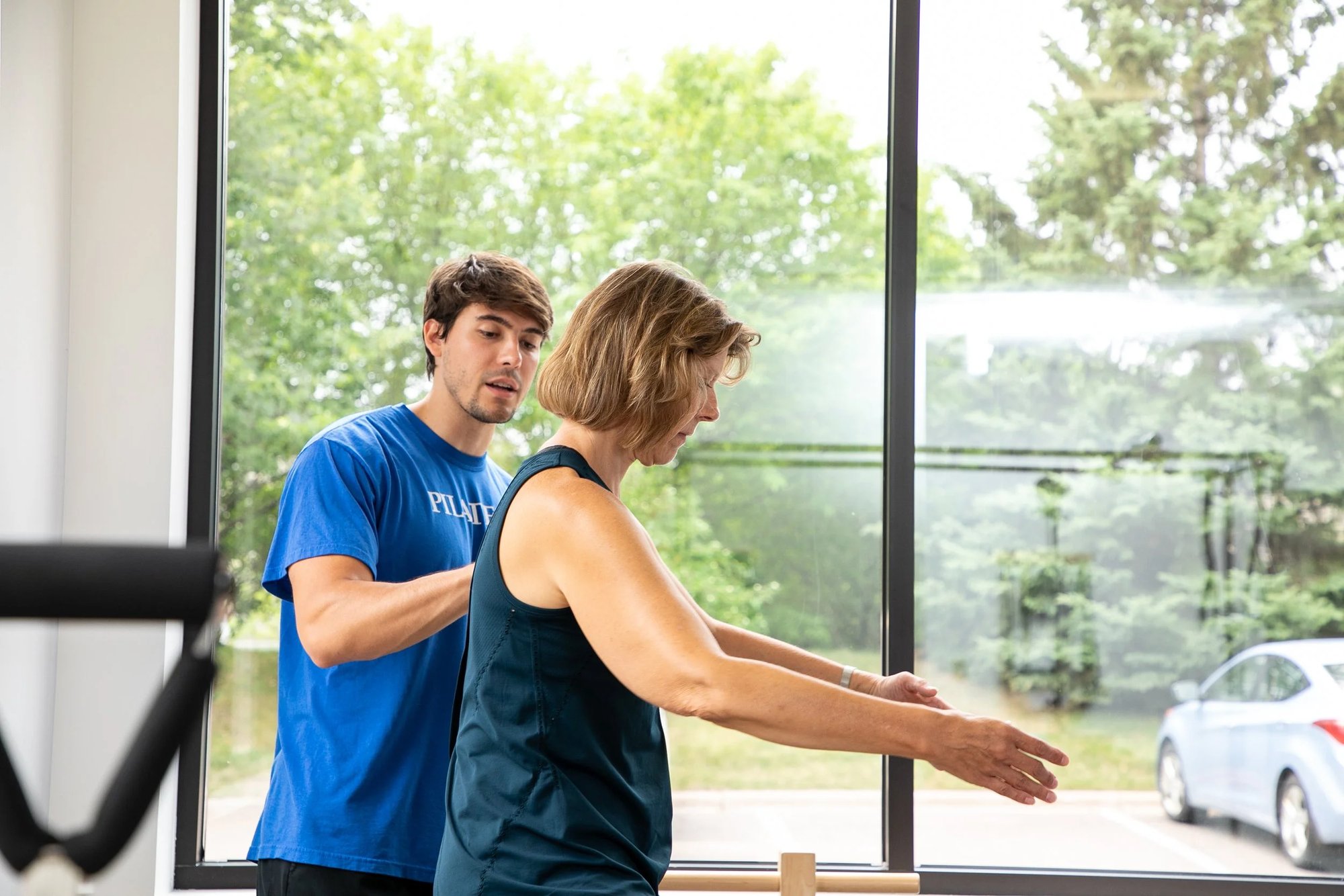
A first physical therapy visit starts with an evaluation. Your therapist looks at how you move, where it hurts, what makes it better or worse, and what your daily life asks of your body. The goal of that first visit is to find the source of the problem, which is often not where the pain shows up. A sore knee can come from the hip. A stiff neck can come from how you sit all day.
Treatment then combines a few things:
Manual therapy, meaning hands-on work on joints and soft tissue
Neuromuscular re-education, which retrains how muscles fire and coordinate after an injury
Pilates-based exercise on the Reformer, Trapeze table and Chair
Standing balance and alignment work on the CoreAlign
Education about your injury, so you understand what you are protecting and why
That last point matters more than people expect. Clients who know why a movement is being changed tend to keep doing the right version of it at home, at work and in class.
Every therapist here also teaches Pilates
This is the part that surprises people. Our therapists write your Pilates program themselves. Each of them teaches Pilates, and many keep ongoing Pilates clients of their own after rehab is done. Some clients choose to keep working with a therapist for their regular Pilates sessions because of that clinical background.
The equipment is the same equipment you will use later in class. So the exercises you learn in treatment are not a separate world. When you move from physical therapy into private Pilates sessions or group classes, the springs, the cues and the positions are already familiar.
Who this tends to help
Our team sees a wide range of people, and a few groups come through the door again and again:
People with back pain who have been told to strengthen their core but do not know where to start
Clients coming off a joint replacement or orthopedic surgery who want a bridge back to normal exercise
People with scoliosis, hypermobility or one-sided weakness, where a standard exercise class does not fit
Clients managing Parkinson's or balance problems
Postpartum clients and people working on pelvic floor and women's health concerns
Anyone with osteoporosis or low bone density who needs to know which movements to change
If you have one of those, our articles on Pilates for back pain and Pilates for osteoporosis go into more detail on what we change and why.
What equipment-based rehab looks like
Most of our rehab happens on spring-loaded equipment. Springs can resist you, but they can also assist you, which means a therapist can make an exercise lighter than gravity alone would allow. That is useful early in recovery, when lifting your own leg or arm through a full range is too much.
Our Reformers are fitted with the Konnector, a single rope with four independent loops, so each arm and leg works against its own resistance. For an injured or weaker side, that keeps the strong side from quietly doing all the work.
What a first visit costs
We do not bill insurance. HSA and FSA funds can be used where they apply, and we can provide an official, itemized bill to submit to your HSA or FSA.
A physical therapy assessment is $200, and sessions with a physical therapist start at $150. Sessions with a physical therapist assistant start at $120. For new clients there is an introductory package: one PT assessment plus four private sessions for $500. Full details are on our pricing page.
How to get started
Call the front desk, tell us briefly what is going on, and we will book your assessment with the right therapist. Before your first visit, fill out the health history form on our physical therapy page and bring it with you, along with a list of any surgeries, diagnoses or imaging you have had. Wear clothes you can move in. You will spend part of the visit talking and part of it moving.
From there, your therapist will tell you honestly what they think you need: a short course of treatment, a longer plan, or a move into private Pilates sessions or classes once you are ready.
Frequently asked questions
Can I get physical therapy and Pilates in the same place in Plymouth, MN?
Yes. Pilates MN in Plymouth has licensed physical therapists and physical therapist assistants on staff, working in the same studio as the Pilates instructors. Rehab and classes are planned together, so you can move from treatment into Pilates without starting over.
Does Pilates MN take insurance for physical therapy?
No. Pilates MN does not bill insurance. HSA and FSA funds can be used where applicable, and we can provide an official, itemized bill to submit to your HSA or FSA.
How much does a physical therapy assessment cost?
A physical therapy assessment at Pilates MN is $200. New clients can choose an introductory package of one assessment plus four private sessions for $500. Single sessions start at $120 with a physical therapist assistant and $150 with a physical therapist.
Do I need a doctor's referral?
Minnesota allows people to see a physical therapist without a referral in many situations. Call the front desk and describe your situation, and they will tell you what applies to you and whether your doctor should be involved first.
What should I bring to my first physical therapy visit?
Bring the completed health history form, a list of past surgeries and diagnoses, any imaging reports you have, and clothes you can move comfortably in. The first visit is part conversation and part movement assessment.