Most back pain we see is not a flexibility problem
People walk into our Plymouth studio with back pain and tell us the same thing in a dozen different ways. They stretched every morning. They bought the foam roller. They did the hamstring routine a coworker swore by. It helped for a day, and then the ache came back. That pattern is so common that we now assume it until proven otherwise: the back is usually not too tight, it is under-controlled. Something above or below it, a hip that stopped working, a pelvis that tips every time a leg moves, a trunk that cannot hold still while the arms reach, is handing the spine a job it was never built to do.
Pilates is good at fixing exactly that. It is not magic and it is not for every back, but for the large middle group of people with nagging, recurring, mechanical low back pain, it is one of the best tools we know.
See someone first if any of these are true
Before the good news, the part we take seriously. Get a doctor or a physical therapist to look at you before you start any exercise program if your back pain came on after a fall or an accident, if you have numbness or weakness running down a leg, if you have any change in bladder or bowel control, if the pain is worse at night and does not ease with rest, or if it comes with a fever or weight loss you cannot explain. Those are not Pilates problems.
If none of that applies but the pain has a story, a disc diagnosis, a past surgery, scoliosis, a flare that keeps coming back, start with an assessment rather than a class. Our physical therapists work in the same building as the instructors, so the person who evaluates your back is the person who later tells your instructor what to keep and what to leave out. You do not have to carry a printout from one place to another and hope it gets read.
Why the Reformer suits a sore back
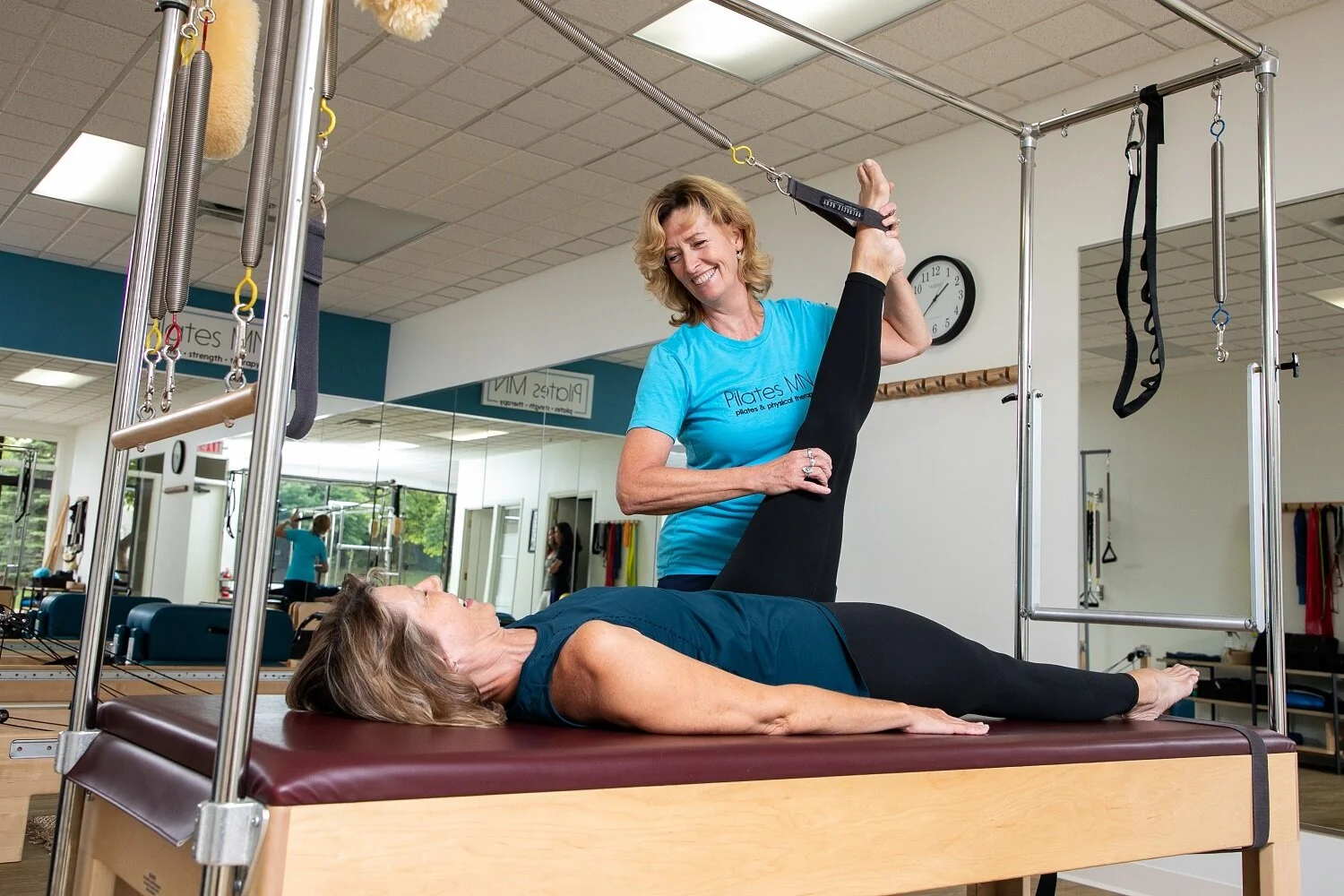
Most back pain flares up under two conditions: load the spine cannot control, and positions it cannot get out of. The Reformer removes both. You can lie down with the spine fully supported and work the legs against springs, so the hips and the deep trunk muscles get stronger without the low back carrying your body weight. The instructor can make the springs lighter or heavier in seconds, which means the same exercise can be a gentle reintroduction on day one and real work by month three.
Our Reformers are also adapted with Konnectors, which give each arm and each leg its own loop and its own resistance. That matters more for backs than people expect. A lot of chronic low back pain is lopsided: one hip stronger, one side of the trunk doing more, a scoliosis curve, an old ankle injury that changed how you walk. On a standard machine the strong side quietly covers for the weak one. On a Konnector it cannot, and you feel the difference within a session or two.
What we usually start with
No two backs get the same program, but the first few weeks tend to look similar. We work on finding a neutral pelvis and keeping it while the legs move, which is less glamorous than it sounds and more useful than almost anything else. Footwork on the Reformer, with the spine supported and the legs pressing against springs. Bridging that peels the spine off the carriage slowly, so you learn to move it one section at a time instead of as a single stiff block. Side-lying leg work for the outer hip muscles that steady the pelvis when you walk. Breathing that lets the trunk brace without holding your breath, because people in pain often grip and stop breathing, and that alone keeps the back irritated.
Then we stand you up. The CoreAlign, a standing unit with two moving carriages, lets us train walking, stepping and turning under control. That is where most backs actually get hurt, in the parking lot and at the grocery store, not lying on a mat.
What we leave out at first
Classical Pilates has a lot of rounding forward in it: roll-ups, rolling like a ball, exercises where you curl the head and shoulders up and hold them there. For many sore backs, particularly ones with irritated discs, those movements are the wrong place to start. We swap them for versions that keep the spine long and bring them back later, if at all.
The opposite can also be true. Some backs, often older ones with narrowing around the nerves, dislike arching and feel better bending forward. That is why we do not run a single back pain routine and why an instructor who knows your history matters more than any exercise list you can find online.
How long it takes
Most people who come twice a week feel a change in three to four weeks, usually as fewer bad days rather than zero pain. Real durability, the point where a long car ride or a weekend of yard work no longer sets you back, tends to take two or three months of steady work. Coming once a week still helps, it just takes longer.
How to start at Pilates MN
If your back has a diagnosis or a history, book a PT assessment ($200), or the new client therapy package, which pairs the assessment with four private sessions for $500. If it is the ordinary, nagging kind with none of the warning signs above, our new client month of unlimited Pilates Principles classes is $99, and the front desk will place you based on what hurts rather than which membership sells best. Privates with a Pilates trainer are $110 if you would rather start one-on-one. You can see every price on our pricing page.
Frequently asked questions
Is Pilates good for lower back pain?
For most mechanical low back pain, yes. Pilates strengthens the muscles that stabilize the spine and pelvis and teaches you to move the legs and arms without the low back taking over. It works best when an instructor or physical therapist adjusts the exercises to your specific back rather than following a generic routine.
Can Pilates make back pain worse?
It can if the wrong exercises are used for your back. Deep forward rounding often irritates disc problems, while heavy arching can aggravate spinal stenosis. A qualified instructor will modify or remove those movements, and anyone with numbness, leg weakness or bladder changes should see a doctor before starting.
Should I see a physical therapist or take a Pilates class for back pain?
If the pain followed an injury, has a diagnosis behind it, or keeps coming back, start with a physical therapist. If it is mild, recent and has no warning signs, a beginner Pilates class with an informed instructor is a reasonable start. At Pilates MN in Plymouth, the PTs and instructors work in the same building and coordinate directly.
How often should I do Pilates for back pain?
Twice a week is the sweet spot for most people. Most clients notice fewer bad days within three to four weeks, and lasting change usually takes two to three months of consistent sessions.
How much does Pilates for back pain cost in Plymouth, MN?
At Pilates MN, new clients can take a month of unlimited foundation classes for $99, private sessions start at $110, and a physical therapy assessment is $200. HSA and FSA funds can be used where applicable.