The diagnosis changes the exercises, not the goal
A DEXA scan comes back with a word on it, osteopenia or osteoporosis, and a lot of people hear the same thing underneath it: be careful, move less, do not fall. The first two parts of that are where people go wrong. Bone responds to load. A skeleton that is protected from every demand gets weaker, not safer. What the diagnosis should change is how you exercise, not whether you do.
We work with a lot of clients who have low bone density at our Plymouth studio, including some who have trained with us for many years. Pilates is a good fit for them, with one big condition. Several of the most famous Pilates exercises are exactly the movements people with osteoporosis are told to avoid, so the program has to be built for you.
The movements we change
The movement that matters most is rounding the spine forward under load. Vertebrae in a spine with low bone density are most vulnerable at the front, and curling forward against resistance or body weight squeezes exactly that part. In classical Pilates that rules out, or heavily modifies, the roll-up, the roll-over, rolling like a ball, the seal, the teaser, and the long series of exercises where you lift the head and shoulders and hold them curled. It is also why sit-ups and crunches are a bad idea outside the studio.
Twisting at the end of your range is the second one. Gentle rotation with a long spine is usually fine and useful, but cranking into a deep twist, especially combined with a forward bend, is not. The same goes for heavy side bending. And anything that could end in a fall, balancing on a moving piece of equipment without support before you are ready, gets introduced slowly and with a hand nearby.
None of this means Pilates is wrong for you. It means a class built around the classical sequence probably is, and that your instructor should know your scan results before your first session.
The movements we keep and build
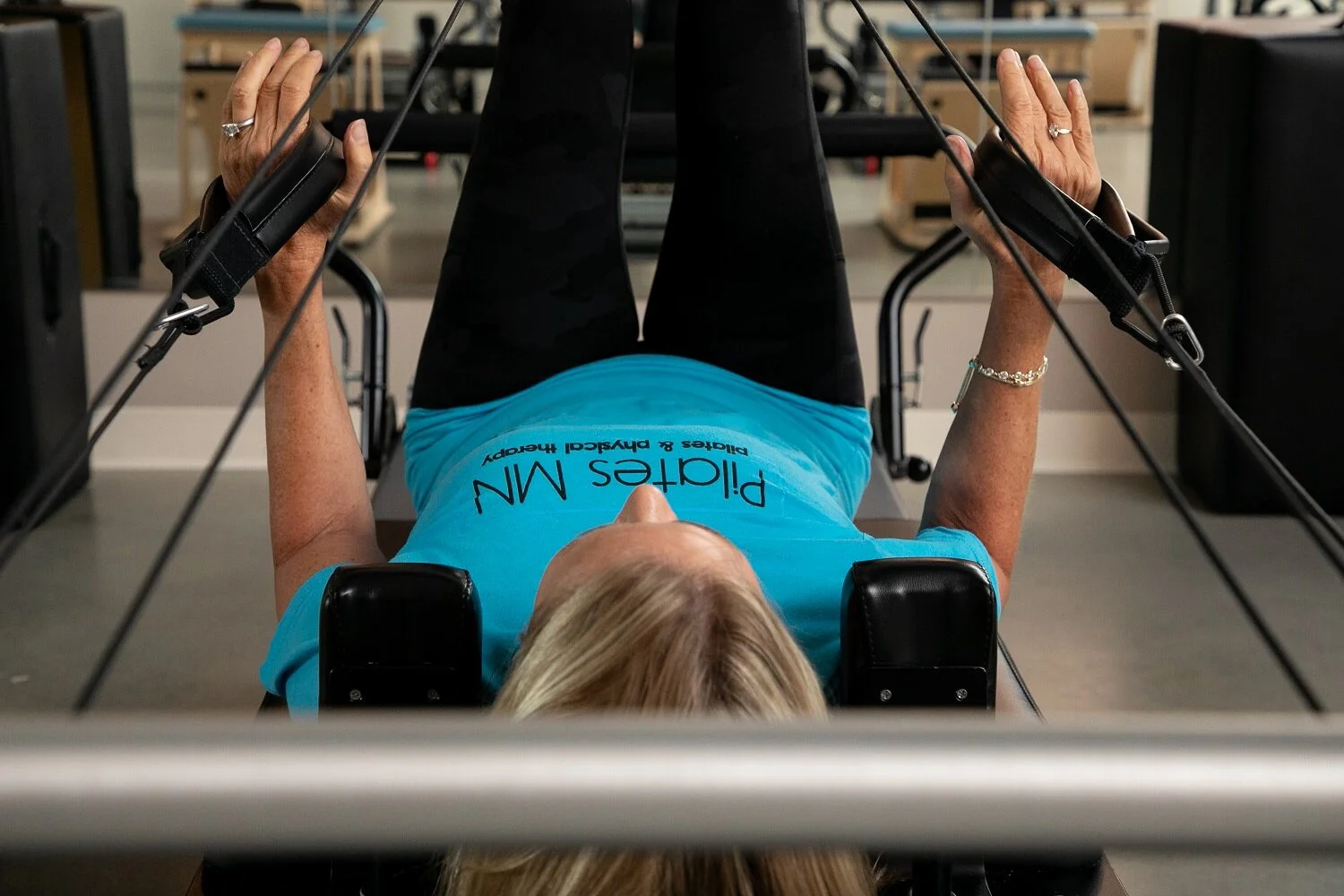
Spinal extension is the headline. Gently lifting the chest and lengthening the upper back strengthens the muscles that hold you upright, and for many people with osteoporosis the forward stoop that creeps in over the years is the thing they most want to stop. On the Reformer we do much of this lying face down, pulling straps or pressing against springs, so the back muscles work without the spine being compressed.
The legs and hips carry a lot of the load. Footwork against springs, standing leg work, and single leg exercises on the Chair build the hip bones and thigh bones, two of the places where fractures do the most damage. Our Konnector-adapted Reformers let us load each leg separately, which matters if one hip is already weaker or replaced.
Balance is the other half of fracture prevention. Most broken hips and wrists start with a fall, so a lot of our work with these clients happens standing up, often on the CoreAlign, where we can train stepping, turning and catching yourself with both hands free to hold on.
Why we pair Pilates with strength training
Here is the honest part. Pilates springs are excellent for control, posture and balance, but on their own they rarely put enough load through the skeleton to build much bone. Heavier resistance does that better. So once a client has the control to do it safely, we usually move them into our small group strength classes, where certified strength trainers coach weighted exercises with the same alignment focus. Pilates makes the strength work safe. The strength work does the bone building. Most people with osteoporosis do best with some of both.
Before your first session
Bring three things: your most recent DEXA results, ideally with the T-scores (minus 1 to minus 2.5 is osteopenia, minus 2.5 or lower is osteoporosis), anything your doctor told you to avoid, and a history of any fractures, including the ones that seemed minor at the time. If you have already had a vertebral fracture or a recent hip fracture, start with our physical therapy team, who work in the same building as the instructors and will hand you over when you are ready for classes. If you have been told to exercise and have no fracture history, a private session or two before joining a group is still the way we would do it.
What it costs to start
Private sessions with a Pilates trainer are $110, or $1,000 for ten. A PT assessment is $200. Once you are ready for groups, a new client month of unlimited Pilates Principles classes is $99 and memberships run $180 to $275 a month. We do not bill insurance, but HSA and FSA funds can be used where applicable.
Frequently asked questions
Is Pilates safe for osteoporosis?
Yes, when it is modified. Exercises that round the spine forward under load, such as roll-ups and rolling like a ball, should be removed or changed, and deep twisting should be avoided. Extension, leg and hip strengthening and balance work are generally safe and useful. Share your DEXA results and your doctor's guidance with your instructor before you start.
What Pilates exercises should you avoid with osteoporosis?
Avoid loaded spinal flexion, which includes the roll-up, roll-over, teaser, rolling like a ball, the seal and sustained curled-up abdominal work. Also avoid forceful twisting at the end of your range, heavy side bending, and any balance challenge you are not yet ready for.
Can Pilates increase bone density?
Pilates on its own provides modest bone loading. It is most useful for posture, balance and fall prevention, and for building the control needed to do heavier strength training safely. Combining Pilates with progressive resistance training is the more reliable way to support bone density.
Where can I do Pilates for osteoporosis near Plymouth, MN?
Our studio, Pilates MN at 2355 Polaris Lane N in Plymouth, works with clients who have osteopenia and osteoporosis, using equipment-based Pilates, small group strength classes and on-site physical therapists who coordinate directly with the instructors.
How often should someone with osteoporosis do Pilates?
Two to three sessions a week works well for most people, ideally with at least one of them focused on strength training once your instructor clears you. Consistency over months matters far more than intensity in any single session.