
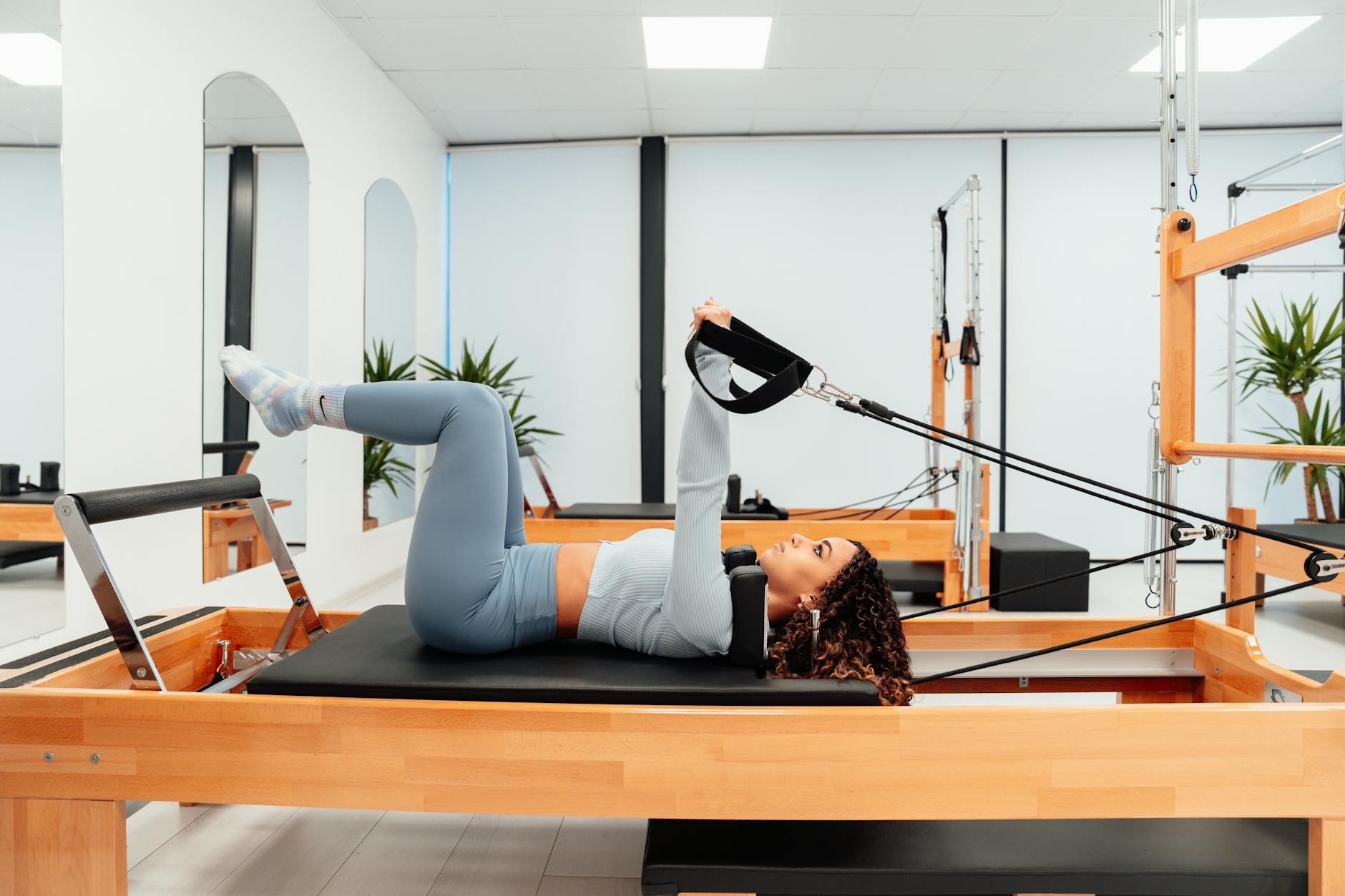
The machine looks worse than it is
Most people walk into a reformer studio for the first time and stop dead in the doorway. There's a padded carriage on rails, a set of springs underneath, straps hanging off a pulley system, and a foot bar. It looks like something you'd get strapped into for physical therapy after a car accident. Which is not far off, since Joseph Pilates built the first versions out of bed frames and springs to rehab bedridden patients.
Here's what actually happens. You lie down on the carriage, put your feet on the bar, and push. The carriage slides out, the springs pull it back, and you control the return. That's the whole mechanism. Every exercise after that is a variation on resisting the springs or being assisted by them. A class runs 50 minutes, usually with six to ten people, and a good instructor spends most of it walking the room adjusting bodies, like telling you to stop shrugging your shoulders up to your ears.
You will not be out of breath the way you are after a spin class. You will shake. There's a specific tremble that shows up in your legs somewhere around minute twenty of your first class, and it means your muscles are being asked to hold a position instead of just moving through one, not that you're doing something wrong. The soreness lands about 36 hours later, usually in places you didn't know were muscles.
Start on the reformer, not the mat
Plenty of instructors will tell you to learn mat Pilates first and earn your way onto the machine. I disagree, and I'll say why. Mat work strips away all the assistance. You're holding your own body weight in positions that require decent hip mobility and a lot of trunk strength you may not have yet. So beginners compensate. They yank on their neck during a roll-up, they let the lower back arch off the floor, and they build the wrong pattern for six months before anyone catches it.
The reformer gives you feedback. If your pelvis rotates, the carriage tells you. If you're pushing through your toes instead of your whole foot, you feel it in the bar. The springs can be set light to assist a movement or heavy to resist it, so a person recovering from a knee replacement and a former college hockey player can be in the same class doing the same exercise at different loads. That flexibility is the entire point of the equipment.
The other reason is honest and a little cynical: people stay with the reformer. Mat classes at home get skipped. A class you paid for, at a studio ten minutes away, with an instructor who noticed you were gone last week, gets attended. Consistency beats purity.
What it costs and what format to pick
Around the Twin Cities, a single drop-in reformer class typically runs $30 to $40, and class packs or a monthly membership bring the per-class cost down closer to the mid twenties. Private sessions are roughly double a group class, sometimes more. Introductory offers are common and worth using, because two or three classes at one studio will tell you more than any amount of reading reviews.
Format | Typical group size | Best for |
|---|---|---|
Intro or fundamentals class | 4 to 8 | First-timers learning spring settings, footwork, and safe setup |
Group reformer (all levels) | 6 to 10 | Ongoing practice once you know the basic vocabulary |
Private session | 1 | Injuries, post-surgery, pregnancy, or a specific goal |
Duet or semi-private | 2 to 3 | Close attention at a lower cost, good with a friend |
If you're dealing with a herniated disc, a recent shoulder repair, or you're in your third trimester, book the private first. Not because group class is unsafe, but because an instructor watching eight people cannot give your situation the attention it needs in week one. After two or three privates you'll know your own modifications well enough to work in a group.
The winter problem
Minnesota studios see the same pattern every year. January fills up. Class waitlists run deep through the first three weeks, and then the middle of February arrives, it's nine degrees at 5:30 in the afternoon, and half those people vanish. The ones who make it to spring almost always did one thing: they booked two specific times per week and treated them like a dentist appointment.
Twice a week is where the change shows up. Once a week keeps you familiar with the exercises but the strength gain is slow enough that most people give up before they notice it. Three times is great if your schedule allows, though for most working adults it becomes the reason they quit. Two is sustainable through a Minnesota February, which is the real test.
Practical things that trip up first-timers here. Grip socks are required at nearly every studio and cost about ten dollars at the front desk, so don't get caught in bare feet. Wear fitted clothing, because the instructor needs to see your ribs and hips, and loose shorts on a reformer are a bad idea when your legs go overhead. And in winter, give yourself an extra ten minutes for parking and boots, since arriving flustered at the last second means you miss the setup portion where the instructor asks about injuries.
Fitted top and leggings or fitted shorts
Grip socks (sticky sole, not regular athletic socks)
Water
A note to yourself about any injury, surgery, or pregnancy, told to the instructor before class starts, not during
How to judge a studio in one visit
Watch what the instructor does with their hands and their attention. Are they on their own reformer at the front demonstrating the entire class, or are they up and walking the room? Demonstrating has its place for a new movement. But if the instructor never leaves their machine for 50 minutes, nobody is correcting your form, and you paid group-class prices for a video you could have streamed.
Listen for spring changes too. A well-taught class adjusts springs several times, and the instructor should be calling out different settings for different people in the room. If everyone is on the same red spring the whole hour, the class is being taught to an average body that nobody in the room actually has.
Last thing. Ask how long the instructors have been at that studio. High turnover usually means the teaching quality swings from month to month, and the whole benefit of a small group is somebody who knows your right hip is tighter than your left. Book an intro class and tell the instructor at the door that it's your first time on a reformer.
Frequently asked questions
How much does a reformer Pilates class cost in Plymouth, MN?
At Pilates MN in Plymouth a single class is $40, a 10-class package is $320, and a 20-class package is $640. New clients can take a month of unlimited Pilates Principles classes for $99, which is the cheapest way to find out whether the reformer suits you. Across the Twin Cities, drop-in reformer classes generally run $30 to $40.
Do I need to learn mat Pilates before I try the reformer?
No. The reformer's springs can assist a movement as easily as they resist it, which makes it the more forgiving place to start. New clients at our Plymouth studio begin in Pilates Principles, a foundation class on the equipment, and check off into Reformer 1 when they are ready.
How often should a beginner take reformer classes?
Twice a week. Once a week keeps the exercises familiar but the strength gains arrive slowly enough that most people quit before they notice them. Three times is fine if your schedule allows it. Two fixed class times each week, treated like appointments, is what carries people through a Minnesota February.
What should I wear to a reformer class?
Fitted leggings or shorts and a fitted top, so the instructor can see your ribs and hips, plus grip socks with a sticky sole. No shoes on the equipment. We sell grip socks at the front desk for about ten dollars if you forget yours.
Can I do reformer Pilates with a back injury or after surgery?
Yes, but start with a private session or a physical therapy assessment rather than a group class. Our licensed physical therapists and PTAs work in the same building as the instructors, and our Konnector-adapted Reformers load each limb independently, which exposes a weak side instead of letting the strong side cover for it.
How is a Konnector-adapted reformer different from a regular one?
A standard reformer runs on springs that load both sides of your body equally. A Konnector uses a single continuous rope with four independent limb loops, so each arm and leg gets its own resistance and a one-sided weakness shows up immediately. It matters most for people coming back from injury, living with scoliosis, or working around a hypermobile joint.