
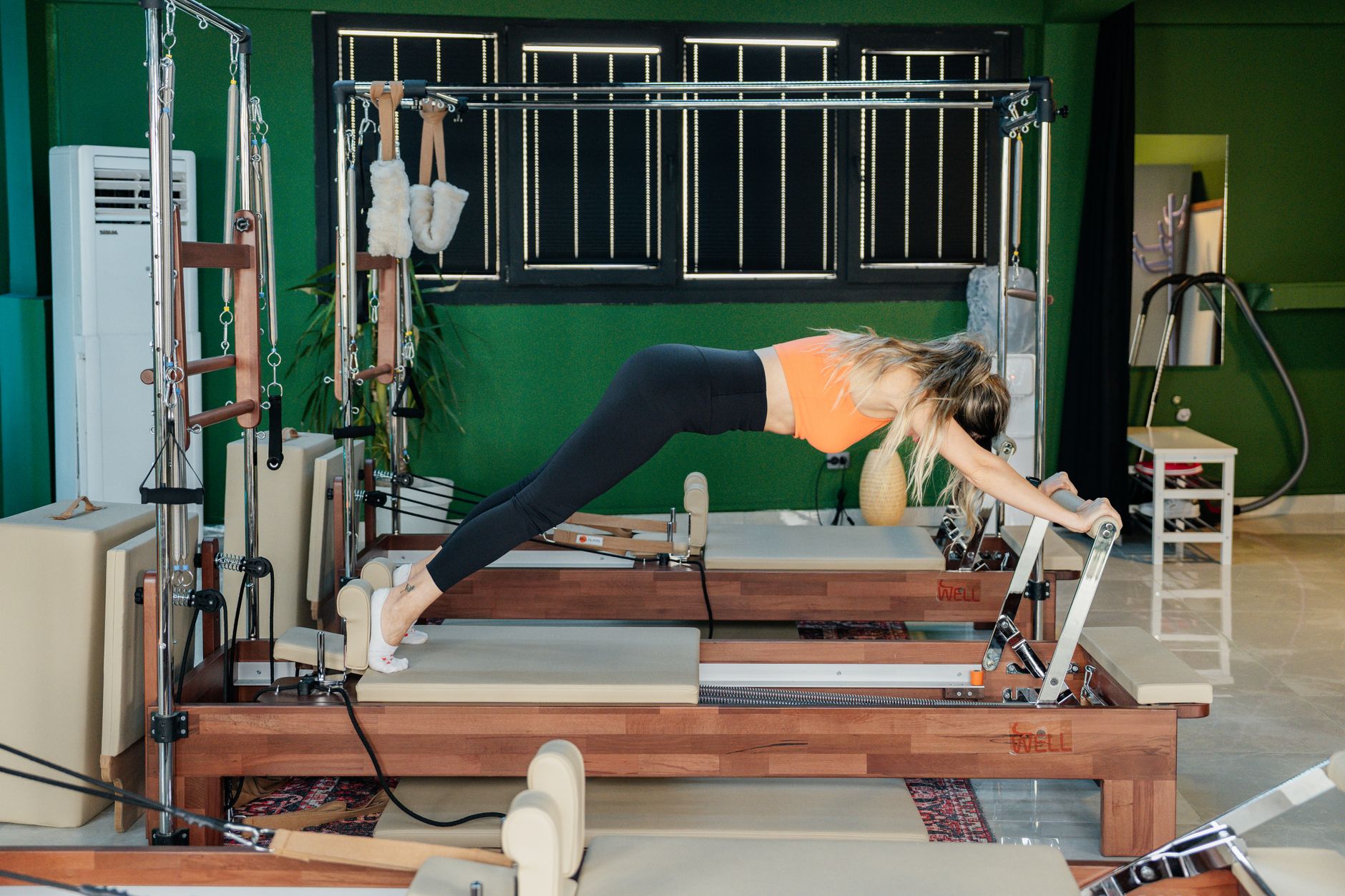
Why winter is a good time for runners to start Pilates
By the end of November, most Twin Cities runners have settled into one of three plans: layering up for icy sidewalks, logging miles on a treadmill, or cutting back until the paths clear in the spring. Whichever camp you are in, your weekly mileage probably drops. That frees up time for the work most runners skip in race season: control around the hips, trunk and feet.
Runners are usually fit, with plenty of lung capacity, and still run into trouble: a hip that aches after long runs, a knee that complains on hills, maybe one side that always tightens first. Pilates is a good fit for that kind of problem, and winter is the easiest time of year to start.

What the research says about Pilates and running
The best single study we know of is a 2018 randomized trial published in PLOS One. Researchers split 32 trained runners into two groups of 16. One group kept running as usual, and the other added a 12-week Pilates program of two one-hour sessions a week. The Pilates group's 5 km time went from 25.65 to 23.23 minutes, while the control group went from 25.33 to 24.61 minutes. The Pilates group also used less energy per meter at the same running speeds.
It is one small study, and the authors' conclusion is measured: the results give a reason to pick strength work that targets the postural and running muscles. Pilates does not replace your runs. It makes the body doing the running more stable.
What Pilates trains that running does not
Running is a single-leg sport repeated thousands of times. Every stride, you land on one foot and your pelvis has to stay level while the other leg swings through. If the muscles on the side of the hip are weak or slow, the pelvis drops, the knee drifts in and the load lands somewhere it should not. More miles rarely fix that, because the body simply works around the weak link.
On the Reformer, Tower and Chair, we slow those patterns down and load them with springs:
Side-lying and standing hip work that trains the pelvis to stay level on one leg
Footwork that builds strength through the ankle, arch and calf in a controlled range
Trunk work that teaches you to breathe and stay stable at the same time, instead of bracing and holding your breath
Rotation work, because your ribs and pelvis counter-rotate with every stride
Side-to-side comparison, so you can feel which leg is doing less
Speed comes from pushing force into the ground through a trunk that does not collapse. When the hips, trunk and feet get stronger and steadier, that force has a cleaner path. You notice it on hills, at the end of long runs and when you try to pick up the pace.
"I've taken 130 sessions at Pilates MN over the last 2 1/2 years. I'm 57 years old, and have worked out regularly for most of my adult life. I've tried many different things and have had many different trainers. The 3 trainers I have had at Pilates MN have been simply the best that I have ever had. The trainers are kind, professional, with a wealth of knowledge. My flexibility has gotten better, my strength has gotten better, my balance has gotten better. I have noticed that I'm even faster in all out sprint than I was 5 years ago. ..."
James H., 5-star Google review, July 2025
Single-leg work on the Konnector
Most Reformers move your arms together and your legs together. Our Reformers are fitted with the Konnector, a single continuous rope with four independent loops, one for each arm and leg. Each limb gets its own resistance, so one leg can work while the other stays still or works against a different load. For runners, that is a big deal. You can finally train the left leg and the right leg as the separate, uneven legs they actually are.
As our Konnector page puts it, "For elite athletes, the same geometry loads rotation, gait, and reactive stability in ways paired straps never could." A weekend 10K runner with one weak hip gets the same benefit.
We also use CoreAlign, a standing unit built for alignment and balance work. Running happens on your feet, so training balance and hip control while standing carries over more directly than lying on your back.
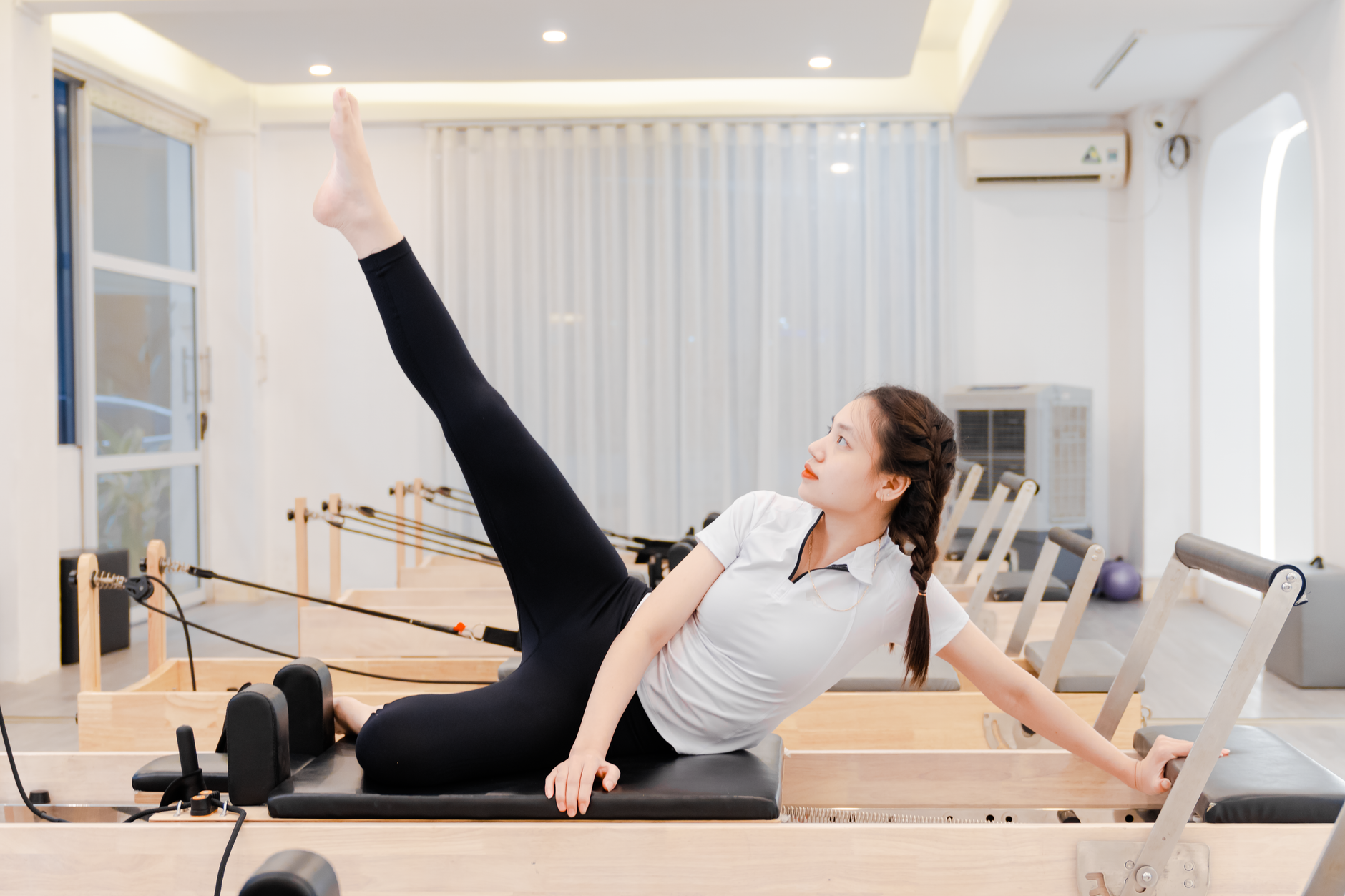
How to fit Pilates into a running week
Here is how we usually suggest runners set it up through the winter:
December through February: two Pilates sessions a week, the same dose used in the study above.
Put Pilates on easy run days or rest days. Avoid the day before a long run or a hard workout.
If you want heavier loading for the legs, add one of our small group strength training circuits. Springs build control; weights build more raw strength.
As spring races approach and mileage climbs, drop to one session a week to hold onto what you built.
Expect the first few weeks to feel humbling. A slow single-leg exercise on the Reformer can shake after eight reps, and that shows you where the weak link has been hiding.
When a running injury needs physical therapy first
If you are running through pain that changes how you move, or pain that lingers after you stop, get it evaluated before adding a new kind of training. Our licensed physical therapists work in the same building as our instructors and coordinate with them directly. A physical therapy assessment is $200. We do not accept insurance, but HSA and FSA funds can be used when applicable.
Where to start at Pilates MN
New clients usually begin with our One Month Unlimited intro for $99, a month of unlimited Pilates Principles classes where you learn the equipment before moving up to Reformer 1. For a plan built around your own stride and history, a private session with a Pilates trainer is $110. All options are on our pricing page.
Frequently asked questions
Can Pilates make you a faster runner?
It can help. In a 2018 randomized trial of 32 trained runners, the group that added 12 weeks of Pilates, two one-hour sessions a week, cut its 5 km time from 25.65 to 23.23 minutes, a bigger decrease than the group that only ran.
How many times a week should a runner do Pilates?
Two sessions a week is a good target during the off-season, and it matches the dose used in the research. During heavy training blocks, one session a week is usually enough to keep the gains. Schedule Pilates on easy days or rest days rather than the day before a long run.
Is Pilates enough strength training for runners?
On its own, Pilates builds control and endurance in the muscles that stabilize a stride. Many runners also benefit from heavier strength training with weights, such as the small group strength circuits at Pilates MN.
Where can runners take Pilates in Plymouth, MN?
Pilates MN at 2355 Polaris Lane N in Plymouth, MN offers group and private Pilates on Konnector-adapted Reformers, which let each leg train with its own resistance. Physical therapists work in the same building for runners who need an injury evaluated first.
How much does it cost for a runner to start Pilates?
At Pilates MN, new clients can start with One Month Unlimited Pilates Principles classes for $99. A single private session with a Pilates trainer is $110, and a physical therapy assessment is $200 if you are dealing with a running injury.