
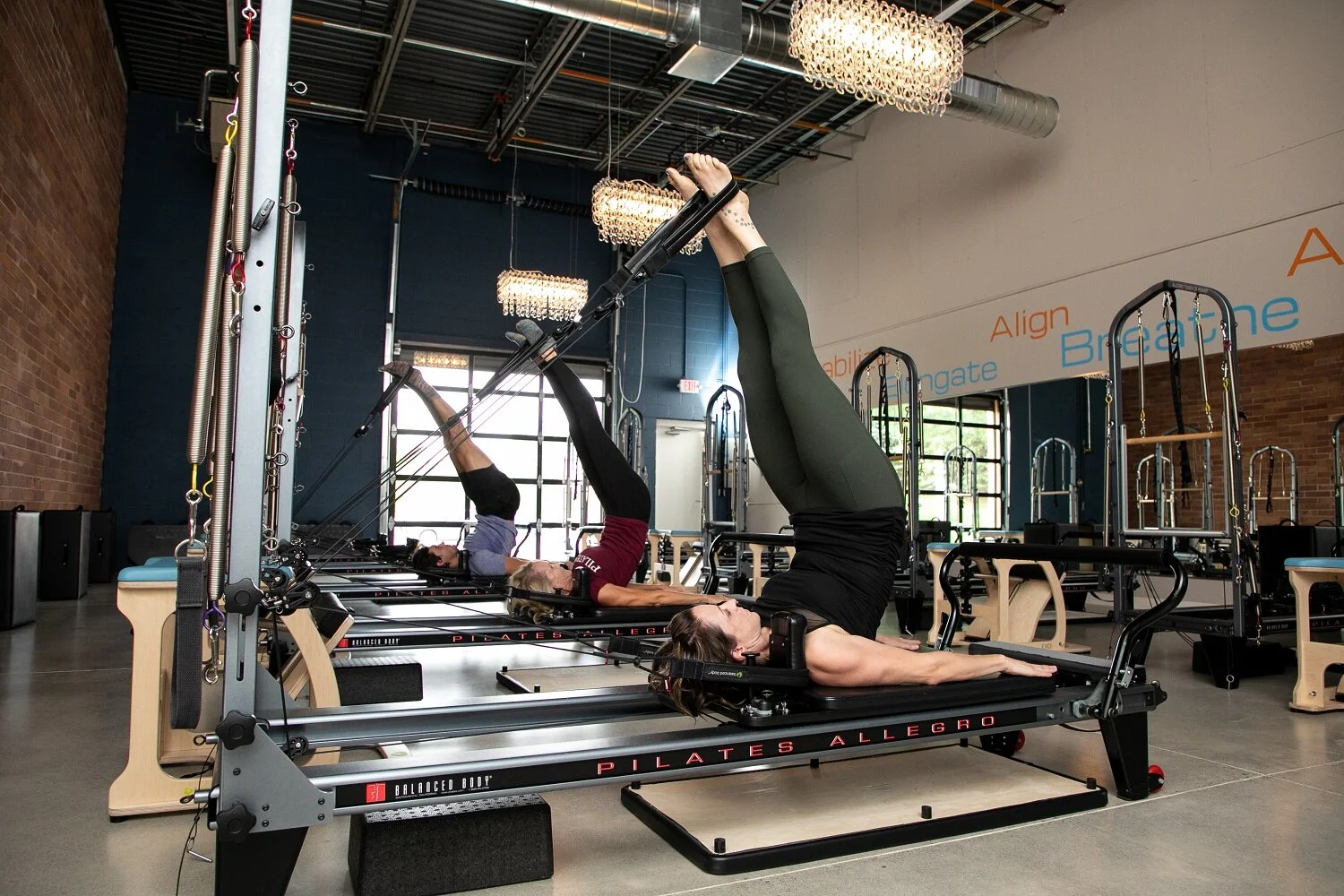
What hypermobility means for exercise
Hypermobile joints move further than average. Some people have one or two loose joints, often shoulders or knees. Others are loose almost everywhere, and some have a diagnosed condition such as hypermobility spectrum disorder or a form of Ehlers-Danlos syndrome. Plenty of hypermobile people were praised for their flexibility growing up, in dance or gymnastics, and only later started noticing sore joints and a sense that their body never quite feels stable.
The issue is usually control at the end of a joint's range. When ligaments allow more motion, muscles have to do more of the work of holding a joint where it belongs. If those muscles are not strong enough, or the body is not getting clear signals about where the joint is, people tend to hang on their ligaments: locked knees when standing, elbows that bend backward in a plank, a lower back that sinks into an arch.
That is why we rarely add stretching for hypermobile clients. Our work with them focuses on strength and awareness inside a range they can control. If you suspect a connective tissue condition but have never been evaluated, talk with your doctor, since some forms affect more than the joints.
Why stretching can backfire
Many hypermobile people love to stretch because it feels good, at least for a moment. The relief usually comes from the stretch sensation itself, and it fades quickly. Pushing into end range over and over can leave already loose joints with even less support, and some people find they feel more achy afterward.
Gentle mobility work still has a place. We keep it short of the end of the range and pair it with strength, so the muscles learn to own the new position.
How we change Pilates for hypermobile bodies
Pilates suits hypermobility well when it is taught for it. The equipment gives us ways to add feedback and support that a mat alone does not. Here is what that tends to look like:
Working in smaller ranges, stopping short of where the joint would happily go
Using springs to give the body something to push against, which helps joints sense where they are
Cueing soft knees and elbows instead of locked ones, many times per session if needed
Slowing exercises down so muscles do the work instead of momentum
Choosing more closed-chain work, where hands or feet press into a bar or footplate
Training balance and alignment standing up on the CoreAlign, where small wobbles show up quickly
Heavier springs are not always harder for a hypermobile client. Sometimes a lighter spring is more challenging, because there is less resistance to lean on and the body has to stabilize on its own. Your instructor will adjust as they watch how your joints behave.
Why the Konnector matters here
Hypermobility is often uneven. One shoulder may be looser than the other, or one knee may hyperextend while the other does not. Our Reformers are fitted with the Konnector, one continuous rope with four independent loops, so each arm and leg works against its own resistance. That lets an instructor see and train the looser side directly, instead of letting the steadier side cover for it.
It also makes it easier to spot a joint that is drifting. When one limb is working on its own, a knee that starts to lock or a shoulder that starts to hike is much harder to hide.
Adding strength training
Many hypermobile clients do well adding strength work alongside Pilates. Our small group strength circuit classes are led by certified strength trainers (who are also Pilates trainers) and focus on alignment, which matters when joints tend to drift into end range under load. Muscle is what holds a loose joint in place, so building it steadily over time is one of the more useful things a hypermobile person can do.
Start light and tell your trainer about your hypermobility before the first class. Good form at a modest weight will serve you better than a heavier load your joints have to hang on to.
When to start with physical therapy
If you have frequent subluxations or dislocations, ongoing joint pain, recent sprains, or symptoms such as dizziness or fatigue that affect daily life, talk with your doctor and start with a physical therapy assessment before group classes. Our physical therapists work with hypermobility and can identify which joints need the most support and how to load you safely.
Every therapist here also teaches Pilates, so the exercises from your treatment carry straight over to private sessions and classes. Our physical therapists and instructors work in the same building and talk to each other, which makes the move from rehab to regular Pilates much smoother.
What it costs to get started
A physical therapy assessment is $200, and new clients can choose one assessment plus four private sessions for $500. Private Pilates sessions are $110 with a Pilates trainer or $115 with a master trainer. If you have no pain and want to start in a group, the One Month Unlimited intro is $99 for unlimited Pilates classes, also including strength classes. We do not bill insurance, though HSA and FSA funds can be used where they apply.
Frequently asked questions
Is Pilates good for hypermobility?
Pilates can be a good fit for hypermobility when it is taught with smaller ranges and spring resistance that gives joints feedback. The aim is building strength and stability around loose joints, so expect less stretching than in a typical class.
Should hypermobile people avoid stretching?
Most hypermobile people do not need more end-range stretching, and repeatedly stretching into the end of the range can leave loose joints less supported. Gentle mobility work that stops short of end range, paired with strength, is usually a better choice.
Can I take group Reformer classes if I am hypermobile?
Many hypermobile clients take group classes, especially after a few private sessions to learn their modifications. Tell each new instructor about your hypermobility before class so they can cue you to stop short of end range.
Where can I get help for hypermobility in Plymouth, MN?
Pilates MN in Plymouth, MN has licensed physical therapists who work with hypermobility, plus Pilates instructors and strength trainers in the same building. A physical therapy assessment is the usual starting point if you have joint pain or frequent injuries.
How much does it cost to start Pilates for hypermobility?
At Pilates MN, a physical therapy assessment is $200, and new clients can choose one assessment plus four private sessions for $500. Private Pilates sessions are $110 with a Pilates trainer. New clients without pain can start with the $99 intro month of Pilates Principles classes.