
Distance is a fine first filter, but it's a lousy last one
Almost everyone finds us the same way. They type the phrase into their phone, they see a map, and they sort by how many minutes it is from the house. I get it. I do the same thing when I need a dentist. But I've watched this play out for eighteen years now, and the studio you stick with is almost never the closest one; it tends to be the one where somebody remembers your name and your shoulder.
We're at 2355 Polaris Lane N in Plymouth, off the northwest side of the metro. Plenty of our clients live in Plymouth. Plenty drive in from Maple Grove, Wayzata, Minnetonka, and Golden Valley, and a handful come farther than they probably should. In January, when the ramp onto 494 is a sheet of glaze and it's dark at five, an extra eight minutes of drive time feels enormous, and then it stops mattering by about week three, once you've got a class time and an instructor you don't want to skip. The membership people abandon in February is usually the convenient one they never actually liked.
So use the map to build a short list. Then judge on the things that decide whether you're still going in six months: who teaches, whether that person changes every month, and whether anyone in the building is qualified to look at the knee you've been babying since 2019.
Here's where I'll disagree with half the industry
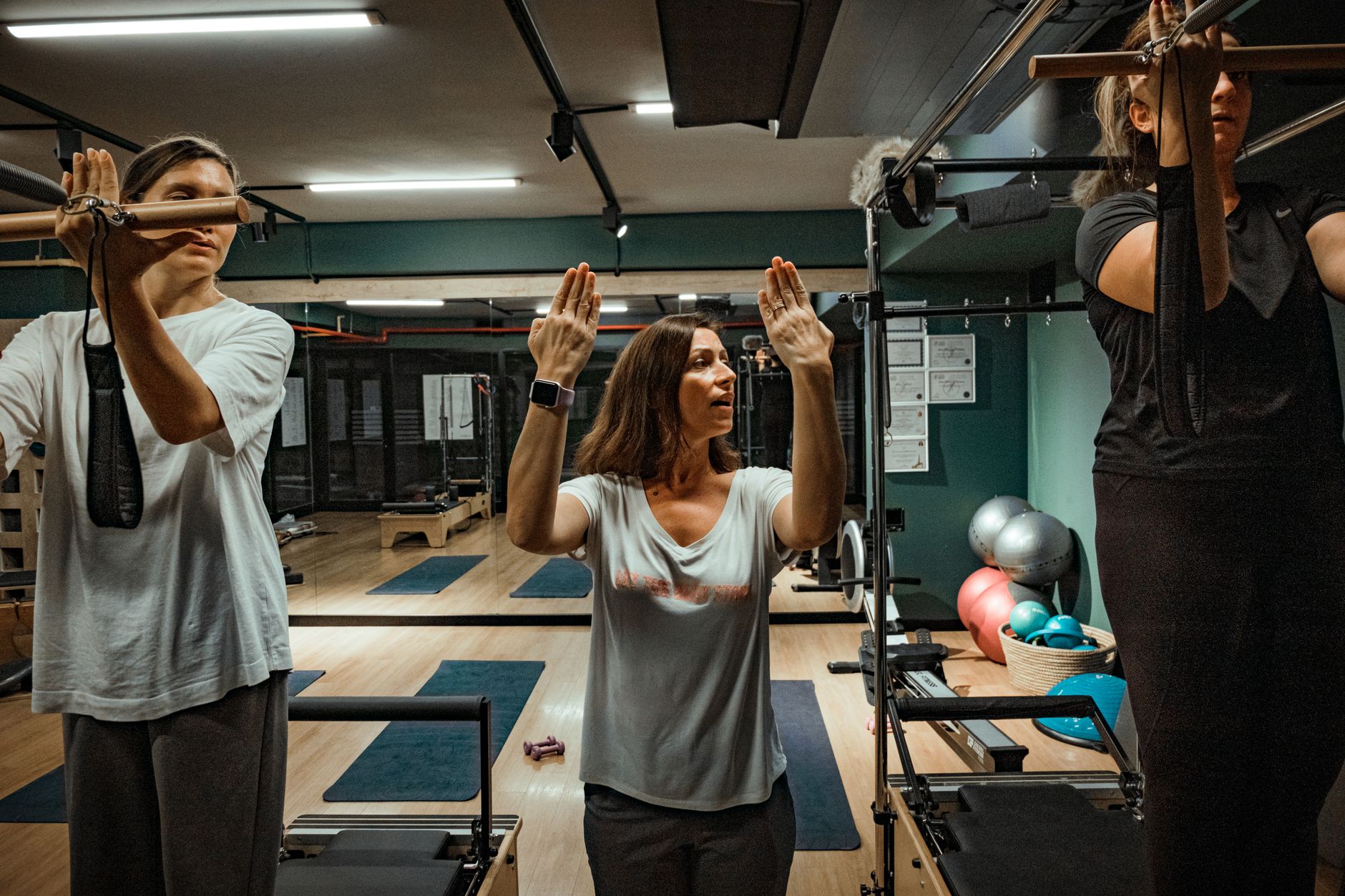
Pilates got popular again, and a lot of what got popular is a heated room, a loud playlist, fifty minutes of fast reformer work, and an instructor at the front who cannot see thirteen bodies at once. People love it. It's a decent workout. But it isn't what Joseph Pilates built, and I wouldn't send a fifty-five-year-old with a cranky lumbar spine into it.
My objection is practical: speed hides compensation. If your right hip is doing seventy percent of the work in a footwork series, you will never feel it at tempo, and neither will anyone watching from across the room. You'll feel great for eight weeks and then you'll feel your SI joint. We teach slower than that on purpose, and we cue alignment more than most clients expect at first. A few people find it fussy. The ones who stay tend to be the ones who tried the fast version and got hurt.
The other thing worth asking about is staff turnover. We have nineteen instructors and clinicians with something north of 300,000 combined hours of teaching and clinical work between them. Pamela has been teaching for forty years and Martha for thirty-eight. Shawn, our training program manager, is a physical therapist with twenty-five years of experience. Jen, Molly, Tina, all fifteen years and up. Clients here have worked with the same instructor for a decade. That continuity is the whole product, honestly. Somebody who watched you rehab a hip replacement in 2021 knows exactly what to change when you show up in 2026 with a frozen shoulder.
The equipment thing you didn't know to ask about
Most studios have Reformers, a Tower and a Chair. We have those too, plus a CoreAlign and a Trapeze. What we also have, and what almost nobody around here has, is Konnector-adapted Reformers.
Quick explanation. A traditional Reformer runs on springs that load both sides equally. If your left side is weaker (post-surgery, post-stroke, scoliosis, a bad ankle you've limped on for two years), the strong side quietly takes over and the machine has no way to notice. The Konnector uses a single continuous rope with four independent limb loops, so your arms and legs are connected to each other through the system. Cheat with one limb and another one has to give. It shows you the asymmetry instead of letting you bury it.
That matters for a specific group of people: anybody coming back from injury or living with a one-sided weakness, and anybody hypermobile who's been sliding into their end ranges their whole life. If you're a healthy thirty-year-old who wants to feel stronger, a regular Reformer is fine. If your body is uneven, and most bodies over forty are, this is worth driving for.
Which class you start in, and what it runs
New people start in Pilates Principles. It's the foundation class, slow enough that you pick up the vocabulary and a Reformer 1 class later doesn't feel like a foreign language. When you're ready, you check off into Reformer 1. From there it's Mix It Up 1.5, then Reformer 2 and above. We also run Pilates Therapy for people managing pain or a chronic condition, plus specialized programming for hypermobility and balance.
Nobody here is going to upsell you. The front desk places people where they'll actually benefit, which sometimes means telling a very fit runner that yes, they should start in Principles like everyone else. Our oldest clients are in their nineties. Our youngest are collegiate athletes.
Pricing, plainly:
Option | Price | Notes |
|---|---|---|
New Client One Month Unlimited | $99 | Unlimited Pilates Principles; check off to Reformer 1 when ready |
Single class | $40 | Drop-in |
10-class package | $320 | Six-month expiration |
20-class package | $640 | No expiration |
Limited monthly | $180/mo | 6 classes; extra classes $30 |
Unlimited monthly | $275/mo | Up to one class daily, 10% off privates, massage, products |
Private Pilates | $110/session | $1,000 for 10; Master Trainer $115 or $1,050 for 10 |
New client PT offer | $500 | One PT assessment plus four private sessions |
Massage | $60 / $110 | 30 or 50 minutes; five-session package $525 |
The $99 month is the honest answer for most people searching around. Four weeks of unlimited foundation classes for roughly the cost of two and a half drop-ins. You'll know by the end of it whether this is your thing.
One team, three disciplines, one building
We opened in 2007 as a Pilates studio. The physical therapy came shortly after. Now our licensed PTs and PTAs work in the same space as the instructors, and they talk to each other daily. If Jenna is treating your knee in a PT suite, Morgan knows what to modify in your Reformer class Thursday morning. That conversation happens in a hallway, not over a fax machine three weeks later.
We don't take insurance. Our PTs will hand you the billing codes so you can submit for reimbursement yourself, and HSA and FSA funds work here when applicable. A PT assessment is $200; sessions run $120 to $165 depending on whether you're seeing a PTA, a physical therapist, or a master level PT.
Hours change by day: Monday 8:00a to 7:00p, Tuesday 7:00a to 7:30p, Wednesday 7:30a to 8:30p, Thursday 6:30a to 8:00p, Friday 7:30a to 5:30p, Saturday 7:30a to 11:30a, and Sunday 9:00a to 11:00a. The early Tuesday and Thursday slots fill with people who work full time. Saturday mornings go fast in winter. Call the desk at 952-476-0304 and tell whoever answers what hurts and what you're trying to get back to doing; that conversation takes four minutes and it's how we figure out which room you belong in.
Frequently asked questions
How much do Pilates classes cost near Plymouth, MN?
At our Plymouth studio a single class is $40, a 10-class package is $320, and monthly memberships run $180 for six classes or $275 for unlimited. New clients can do a month of unlimited Pilates Principles classes for $99, which is the cheapest realistic way to find out if group Pilates suits you. Private one-on-one sessions are $110 per session, or $1,000 for a package of ten.
I've never done Pilates. Which class should I book first?
Start in Pilates Principles. It's the foundation-level class where you learn the equipment and the basic repertoire at a pace where you can actually feel what you're doing, and it's the prerequisite for moving into Reformer 1. Being fit doesn't let you skip it; runners and lifters often have the most to unlearn about how they load one side of the body.
Can I do Pilates if I'm recovering from an injury or surgery?
Yes, and that's a large share of what we do. We have licensed physical therapists and PTAs on site working in the same space as the Pilates instructors, so treatment and classes stay coordinated, and our Konnector-adapted Reformers are built to expose one-sided weakness that a standard Reformer lets you hide. Post-surgical clients usually start with private sessions or PT before joining a group class.
Do you accept insurance for physical therapy?
We don't bill insurance directly. We accept HSA and FSA funds where they apply. A PT assessment is $200, and there's a new client package of one assessment plus four private sessions for $500.
What are your hours, and how far ahead should I book a class?
Our hours change by day: Monday 8:00a to 7:00p, Tuesday 7:00a to 7:30p, Wednesday 7:30a to 8:30p, Thursday 6:30a to 8:00p, Friday 7:30a to 5:30p, Saturday 7:30a to 11:30a, and Sunday 9:00a to 11:00a. Book early-morning weekday slots and Saturday mornings at least a few days out, especially January through March when Twin Cities studios are busiest. Midday weekday classes usually have space the same week.
What should I wear to my first class?
Fitted athletic clothes you can move in, nothing baggy enough to hide your alignment from the instructor, and grip socks (we sell them at the front desk if you don't have a pair). No shoes on the equipment. Arrive ten minutes early on your first visit so we can walk you through the Reformer before class starts.